
Remove “Account abnormal login reminder” phishing email
The “Account abnormal login reminder” email scam is a phishing email that falsely alerts recipients about suspicious activity on their accounts. These emails typically claim that unusual or unauthorized login attempts have been detected, suggesting that someone may be trying to access the account without permission. Despite the alarming tone, these messages are not legitimate security notifications and are instead created by cybercriminals to steal sensitive information.
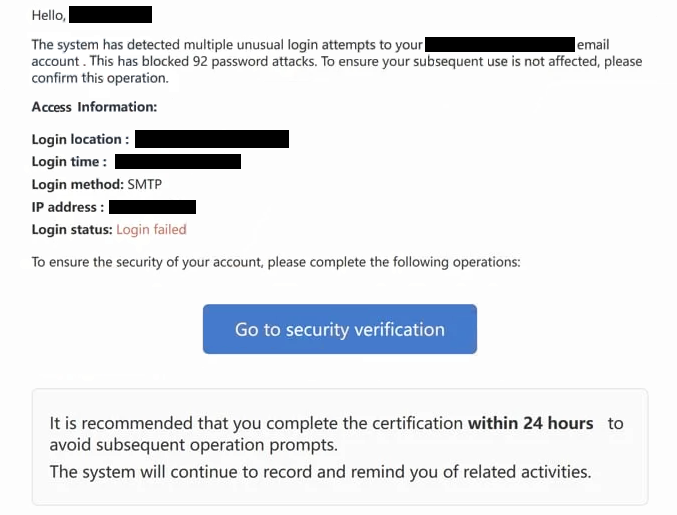
The content of the email is carefully crafted to appear convincing. It often includes warnings about login attempts from unfamiliar locations, unknown devices, or repeated password failures. In some cases, the message may list fabricated details such as IP addresses, timestamps, or geographic regions to make the alert seem more technical and authentic. The goal is to create a sense of urgency so that recipients act quickly without verifying the message.
To “secure” the account, the email usually instructs the recipient to click a link or confirm their identity. This link does not lead to a real service provider. Instead, it redirects users to a fake login page that mimics a legitimate website. Victims are then asked to enter their username, password, or other personal details. Once submitted, this information is captured by the attackers and can be used for unauthorized access.
Some variations of the scam go further by requesting additional data such as phone numbers, verification codes, or even payment information. This expands the scope of the attack, allowing cybercriminals to carry out identity theft, financial fraud, or further account takeovers. In certain cases, compromised accounts are later used to send more phishing emails, spreading the scam even further.
The consequences of falling for this type of phishing attempt can be significant. Attackers who gain access to login credentials may take control of email accounts, social media profiles, or online services. From there, they can reset passwords for other platforms, access private communications, or exploit stored data. This can lead to privacy breaches, financial losses, and long-term security issues.
It is important to understand that legitimate companies do not ask users to verify account details through unsolicited email links. Real security alerts typically advise users to log in through official websites or apps rather than providing direct links that request sensitive information. Any unexpected email claiming urgent account problems should therefore be treated with skepticism.
The “Account abnormal login reminder” phishing email text is below:
Subject: Account abnormal login reminder –
Hello, –
The system has detected multiple unusual login attempts to your – email account . This has blocked 92 password attacks. To ensure your subsequent use is not affected, please confirm this operation.
Access Information:
Login location : –
Login time : –
Login method: SMTP
IP address : –
Login status: Login failedTo ensure the security of your account, please complete the following operations:
Go to security verificationIt is recommended that you complete the certification within 24 hours to avoid subsequent operation prompts.
The system will continue to record and remind you of related activities.
This email is automatically sent by the system. Please do not reply directly. If you are operating this personally, you can ignore this reminder.
Notification time: 3/7/2026 (GMT+08:00)
Ref-ID: –
How this scam spreads and how to avoid it
The “Account abnormal login reminder” scam is most commonly distributed through bulk spam email campaigns. Cybercriminals use automated systems to send large volumes of messages to random recipients. Even if only a small percentage of users respond, the attackers can still obtain valuable information.
To increase credibility, scammers often use spoofed sender identities. The email may appear to come from a trusted company, such as a well-known email provider, social media platform, or financial service. However, a closer look at the sender’s address usually reveals inconsistencies, such as unusual domain names or subtle misspellings.
These emails rely heavily on psychological pressure. By warning about suspicious logins or potential account breaches, they create fear and urgency. This encourages recipients to click links or follow instructions without carefully checking whether the message is genuine. In some cases, the email may even threaten account suspension or data loss if no action is taken immediately.
The phishing process often involves redirecting users through multiple web pages before reaching the final fraudulent login site. This technique helps attackers bypass basic security filters and makes the link appear less obviously malicious. Some fake pages are highly convincing, closely resembling official login portals in design and layout.
Avoiding this scam requires a cautious and methodical approach to email security. One of the most effective steps is to verify the sender’s authenticity before taking any action. If the email address does not exactly match the official domain of the company it claims to represent, it should be considered suspicious.
Users should also avoid clicking on links in unexpected emails, especially those that request immediate action. Instead, if there is concern about account security, it is safer to manually visit the official website by typing its address into a browser and checking for notifications there.
Additional protection can be achieved by enabling two-factor authentication (2FA) on important accounts. This adds an extra layer of security, making it more difficult for attackers to gain access even if credentials are compromised. Using strong, unique passwords for different services further reduces risk.
Keeping software and security tools up to date is also important, as modern protection systems can detect phishing attempts and block malicious websites. Regularly reviewing account activity can help users quickly identify and respond to any genuine security issues.
In essence, the “Account abnormal login reminder” email scam depends on deception and urgency to succeed. By staying alert, questioning unexpected messages, and avoiding interaction with suspicious links, users can effectively protect their accounts and personal information from this type of phishing attack.
Site Disclaimer
WiperSoft.com is not sponsored, affiliated, linked to or owned by malware developers or distributors that are referred to in this article. The article does NOT endorse or promote malicious programs. The intention behind it is to present useful information that will help users to detect and eliminate malware from their computer by using WiperSoft and/or the manual removal guide.
The article should only be used for educational purposes. If you follow the instructions provided in the article, you agree to be bound by this disclaimer. We do not guarantee that the article will aid you in completely removing the malware from your PC. Malicious programs are constantly developing, which is why it is not always easy or possible to clean the computer by using only the manual removal guide.