
Remove “Cloud Storage Renewal Failed” phishing email
The “Cloud Storage Renewal Failed” email scam is a phishing message that pretends to be a final notice from a cloud storage provider. It falsely claims that the recipient’s subscription renewal or payment attempt has failed, putting their stored files at risk. In reality, this message is not legitimate and is designed to trick users into visiting deceptive websites and taking harmful actions.
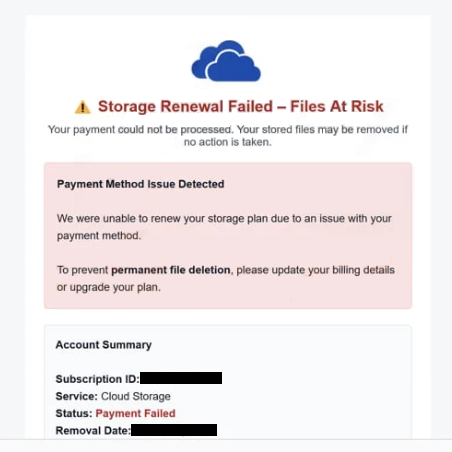
The email typically warns that important data, such as photos, videos, and documents, may be deleted or become inaccessible if the issue is not resolved immediately. It may also state that backups have stopped working, file syncing has been interrupted, or access to cloud services has been restricted. These alarming claims are entirely fabricated and are meant to create panic.
To make the message appear more convincing, scammers often include fake details such as subscription IDs, service names, expiration dates, or account status information. These elements give the impression that the email is a genuine system notification, even though none of the information is real.
Recipients are usually urged to click a button or link labeled with phrases like “Update Payment & Secure My Files.” This link does not lead to an official service. Instead, it redirects users to fraudulent pages that repeat the same warnings and pressure them to act quickly.
Unlike typical phishing scams that aim to steal login credentials directly, this campaign often focuses on affiliate fraud. The scam pages may promote legitimate products or services, but they do so using deceptive tactics. When victims click the provided links and sign up or make purchases, the scammers earn commissions through affiliate programs.
However, the risks do not end there. These campaigns can also expose users to more serious threats. Some links may lead to phishing pages that request personal or financial information, while others may distribute malicious files disguised as documents or updates. This can result in data theft, malware infections, or unauthorized transactions.
It is important to understand that legitimate cloud service providers do not send unsolicited emails demanding immediate payment updates through embedded links. Any message claiming that files will be deleted unless urgent action is taken should be treated with suspicion.
How this scam spreads and how to avoid it
The “Cloud Storage Renewal Failed” scam is mainly distributed through large-scale spam email campaigns. Cybercriminals send these messages to thousands of recipients, relying on fear and urgency to convince some users to respond.
To increase effectiveness, attackers often vary the wording of the emails while keeping the same core message. Subject lines may include phrases like “Payment Declined,” “Immediate Action Required,” or “Account Suspension Notice.” Some messages even include personal names or email addresses to make them appear more legitimate.
Another common tactic is the use of spoofed or misleading sender addresses. The email may appear to come from a trusted company, but the actual domain is usually unrelated or slightly altered. This technique helps scammers bypass initial suspicion and encourages recipients to trust the message.
The scam relies heavily on psychological pressure. By warning about potential data loss or account restrictions, it pushes users to act quickly without verifying the authenticity of the email. This urgency is one of the clearest signs of a phishing attempt.
Avoiding this type of scam requires careful attention to unexpected messages. Users should avoid clicking links or downloading attachments from emails that claim urgent account issues. Instead, if there is concern about a cloud account, it is safer to visit the official website directly and check for notifications there.
It is also important to examine the sender’s email address closely. Any inconsistencies, unusual domains, or generic greetings are strong indicators that the message is fraudulent.
Additional protection can be achieved by enabling two-factor authentication (2FA) and using strong, unique passwords. Even if credentials are compromised, these measures can help prevent unauthorized access. Keeping software updated and using reliable security tools can also reduce the risk of phishing attacks and malicious downloads.
In summary, the “Cloud Storage Renewal Failed” email scam uses fear, urgency, and deception to manipulate users into clicking malicious links or making unnecessary purchases. By staying cautious and verifying messages independently, users can effectively protect their data and avoid falling victim to this type of fraud.
Site Disclaimer
WiperSoft.com is not sponsored, affiliated, linked to or owned by malware developers or distributors that are referred to in this article. The article does NOT endorse or promote malicious programs. The intention behind it is to present useful information that will help users to detect and eliminate malware from their computer by using WiperSoft and/or the manual removal guide.
The article should only be used for educational purposes. If you follow the instructions provided in the article, you agree to be bound by this disclaimer. We do not guarantee that the article will aid you in completely removing the malware from your PC. Malicious programs are constantly developing, which is why it is not always easy or possible to clean the computer by using only the manual removal guide.