
Remove “Rainbow Lottery” email scam
The “Rainbow Lottery” email scam is a fraudulent message designed to trick recipients into believing that they have won a large lottery prize. In reality, the message is part of a phishing campaign created by cybercriminals who attempt to steal personal information or money from unsuspecting victims. The email typically claims that the recipient’s email address was randomly selected as the winner of a large cash prize, often around £1,000,000, supposedly from a “Rainbow Lotto” promotion.
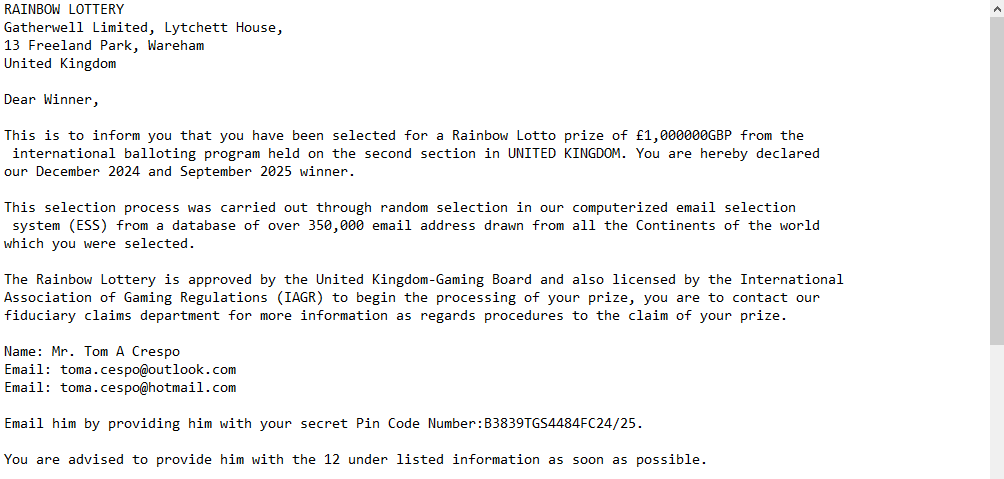
These emails are entirely fake and have no connection to any legitimate lottery organization or regulatory authority. The scammers rely on the excitement of receiving unexpected winnings to convince recipients that the message is genuine. In most cases, the email congratulates the recipient and states that their address was selected from a large pool of international email accounts during an automated lottery drawing.
To claim the supposed prize, recipients are instructed to contact a “claims department” or a representative associated with the lottery. The message usually asks the recipient to provide a range of personal details that the scammers claim are required to process the winnings. These details often include the recipient’s full name, age, gender, occupation, nationality, home address, phone number, and email address.
Providing this information can have serious consequences. Cybercriminals can use the collected data for identity theft, fraudulent transactions, or further phishing attacks. In many cases, the stolen information is also sold to other criminals who specialize in scams, spam campaigns, or financial fraud.
Lottery scams like this one are a form of social engineering, meaning they rely on manipulation rather than technical exploits. Instead of hacking computers directly, scammers attempt to persuade victims to voluntarily share sensitive information or send money. Once the victim responds to the email, the scammers may continue the conversation and claim that certain fees must be paid before the winnings can be released. These payments are often described as administrative charges, processing fees, insurance costs, or tax payments.
Victims who send money do not receive anything in return. After collecting the payment, scammers typically disappear or continue requesting additional fees under new pretexts. Because the supposed lottery prize does not exist, any money sent to the scammers is permanently lost.
Even if victims do not send money immediately, responding to the email can still create problems. Once scammers confirm that an email address is active, they may send additional scam messages or share the address with other criminals. As a result, victims may start receiving a large number of phishing emails, scam phone calls, or fraudulent offers.
In summary, the “Rainbow Lottery” message is a typical lottery fraud scheme designed to exploit curiosity and excitement. Trusting the claims made in these emails can result in financial losses, identity theft, and privacy issues, which is why cybersecurity experts strongly recommend ignoring them entirely.
How the scam spreads and how to avoid it
The “Rainbow Lottery” scam is usually distributed through mass spam email campaigns. Cybercriminals use automated tools to send large numbers of fraudulent emails to people around the world. These campaigns rely on the fact that even if only a small percentage of recipients respond, the scammers can still make significant profits.
Spam messages of this type often originate from compromised email accounts or addresses created specifically for scam campaigns. The sender may appear to represent a lottery organization, prize distribution company, or claims department. However, the actual email address usually belongs to a free email service or a domain unrelated to any real lottery organization.
The structure of the message typically follows a predictable pattern. First, the email congratulates the recipient and claims that they have been randomly selected as the winner of a large prize. Then it explains that the prize can only be claimed after contacting a designated “agent” or department. Finally, the message instructs the recipient to provide personal information or follow specific instructions to initiate the claim process.
Many lottery scams also include fake reference numbers, ticket numbers, or batch codes to make the message appear more convincing. These details are entirely fabricated but are meant to create the illusion that a real lottery drawing has taken place.
In some cases, scammers will also attempt to obtain money from victims by requesting payments for supposed administrative procedures. They may claim that the winner must pay for insurance coverage, bank transfer charges, government taxes, or courier services before the prize can be delivered. This technique is known as advance-fee fraud, where victims are asked to pay upfront fees for rewards that do not exist.
Avoiding scams like the “Rainbow Lottery” email requires awareness of how legitimate lotteries operate. In real lotteries, winners are contacted only if they have actually purchased a ticket. It is impossible to win a legitimate lottery without participating in it. Therefore, any message claiming that someone has won a lottery they never entered is almost certainly fraudulent.
Another warning sign is a request for personal information or payment in order to claim the prize. Legitimate lottery organizations typically deduct taxes or fees from the winnings rather than requiring winners to pay money upfront.
Users can protect themselves by following several basic precautions. Suspicious emails that promise prizes, rewards, or unexpected financial benefits should always be treated with skepticism. Messages requesting sensitive information such as addresses, identification documents, or financial details should never be trusted unless the sender has been verified.
It is also advisable to avoid replying to suspicious emails or clicking any links they contain. Instead, such messages should be deleted or reported as spam. Maintaining updated security software and email filtering systems can also help reduce the number of scam messages that reach the inbox.
Overall, the “Rainbow Lottery” email scam is one of many fraudulent campaigns that exploit the promise of easy money to deceive victims. By recognizing the warning signs and understanding how these scams operate, users can significantly reduce the risk of becoming targets of similar online fraud schemes.
Site Disclaimer
WiperSoft.com is not sponsored, affiliated, linked to or owned by malware developers or distributors that are referred to in this article. The article does NOT endorse or promote malicious programs. The intention behind it is to present useful information that will help users to detect and eliminate malware from their computer by using WiperSoft and/or the manual removal guide.
The article should only be used for educational purposes. If you follow the instructions provided in the article, you agree to be bound by this disclaimer. We do not guarantee that the article will aid you in completely removing the malware from your PC. Malicious programs are constantly developing, which is why it is not always easy or possible to clean the computer by using only the manual removal guide.